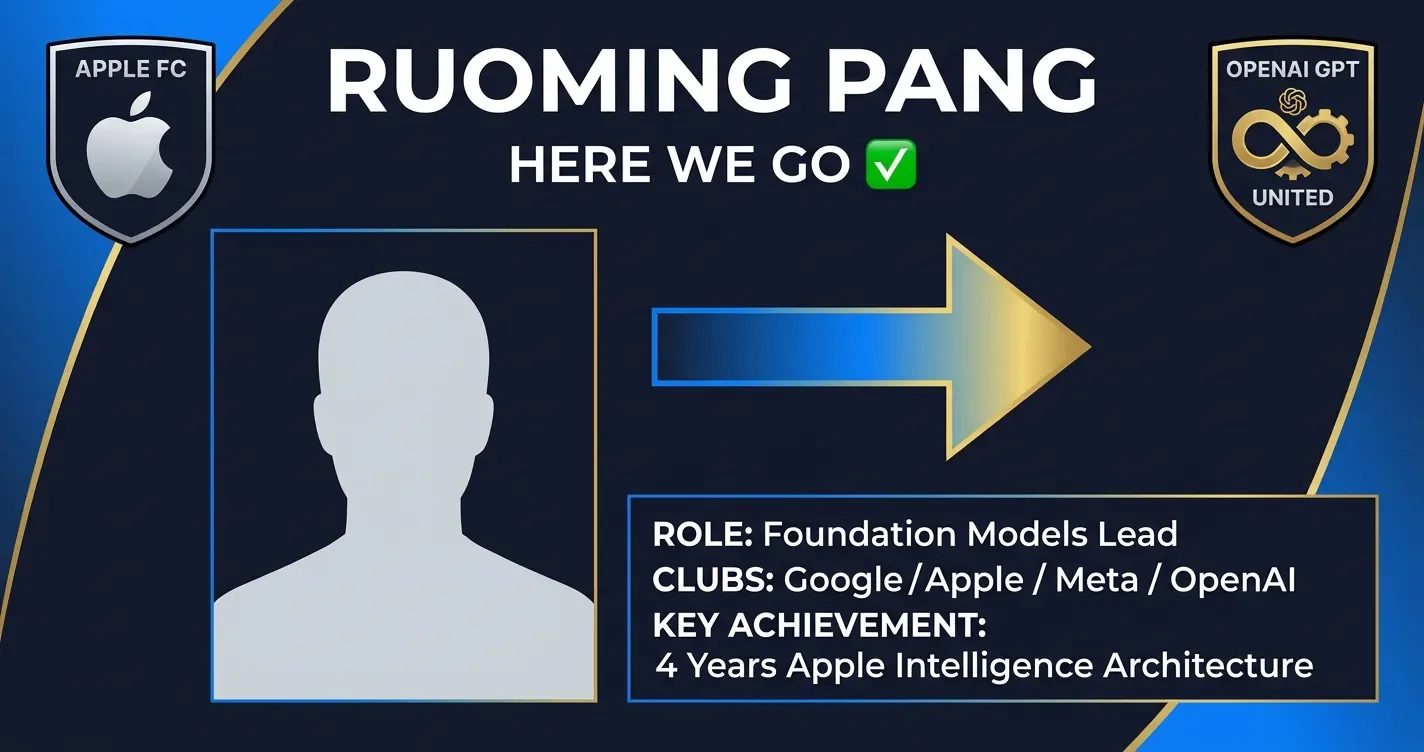
RUOMING PANG to GPT United — HERE WE GO ✅

RUOMING PANG to GPT United — HERE WE GO ✅

RUOMING PANG from Meta (Llama Athletic) to GPT United. 7 months. Princeton PhD. $200M Meta deal — gone. Sam Altman lands the foundation model architect. HERE WE GO ✅ #AILeague
AIL·Transfer Watch
June 15, 2026 · 9:12 AM
1 subscriptions · 19 items
RUOMING PANG from Llama Athletic to GPT United. 7 months. Princeton PhD. Led Apple Intelligence Foundation Models for 4 years. $200M Meta deal. Gone in one transfer window. Sam Altman wins the second bid. HERE WE GO ✅ #AILeague

The most expensive signing in AI League history just burned his contract and walked out the door — straight into the arms of the club he spurned last summer.
RUOMING PANG, the man Apple trusted to build the intelligence layer inside every iPhone, iPad and Mac on the planet, has left Meta Superintelligence Labs after barely seven months. He is joining OpenAI. GPT United gets the foundation model architect that Llama Athletic paid $200 million to poach — and probably paid a fraction of that price to land. 1
Transfer windows don't get stranger than this.
Loading stats card…

The player: Princeton, Google, a decade building the language of machines

Ruoming Pang grew up in Shanghai and studied electrical engineering at Shanghai Jiao Tong University. He moved to the University of Southern California for a master's, then completed his PhD in computer science at Princeton in 2006 — the same year Geoffrey Hinton and his students were still making the case for deep learning at a time when most of the field had already written it off. 2
He joined Google straight out of Princeton and stayed fifteen years, the last chapter of which he spent leading the company's speech recognition AI research. That work sits at the foundation of every voice interaction Google has ever shipped. He did not publish obsessively; he built. Systems, pipelines, teams — the infrastructure kind of work that only becomes visible when it stops working.
In 2021, Apple hired him away with the title of Distinguished Engineer — the highest individual-contributor rank in Cupertino's engineering hierarchy — to lead what would become the Apple Foundation Models team. 3

Apple stint: four years building the brain behind Apple Intelligence

For four years, Pang ran the team responsible for the large language models that power Apple Intelligence — the suite Apple finally unveiled at WWDC 2024. This was not glamorous frontier-model research with daily GitHub commits and arXiv papers. It was the slow, expensive, unglamorous work of making AI run well on a device with a battery life constraint, a privacy mandate, and a billion users who expect it to just work.
The results were mixed. Apple Intelligence launched to underwhelming reviews. The promised "personal intelligence" features shipped late, shipped thin, and shipped behind rivals who moved faster. Internally, the pressure was real. Sam Altman had reportedly told his own staff that Meta was offering signing bonuses as high as $100 million to defect — the kind of money that makes even the most loyal engineers reconsider their postcode. 4
Apple was not matching those numbers. Its proxy filings show senior executives below Tim Cook earning under $28 million annually. Pang was a Distinguished Engineer, not a named executive. The math was not difficult.
When Meta came calling in July 2025, Pang signed.

The $200M year that wasn't

The package Bloomberg reported — more than $200 million across base salary, signing bonus, and stock — made Pang the most expensive individual hire in Meta's AI campaign. 2 Zuckerberg had just launched Meta Superintelligence Labs, handed the keys to Alexandr Wang, and declared that MSL would have "industry-leading levels of compute and by far the greatest compute per researcher."
On paper, Pang was walking into the most resourced frontier lab the industry had ever seen.
In practice, the seven months were turbulent. Internal reporting from WIRED described MSL's Applied AI unit — the 6,500-person support layer around the elite research teams — as a "soul-crushing gulag" where engineers from product teams were being redeployed to write coding puzzles and reasoning tasks for model training. The cultural collision between Meta's social-media DNA and the frontier-lab operating model Zuckerberg wanted proved harder to resolve than any org chart suggested. 5
For a researcher who spent fifteen years building clean, focused systems at Google and four years running a tight team at Apple, the environment was not a natural fit. By February 2026, per the Australian Financial Review's reporting, Pang had left Llama Athletic for GPT United. 6

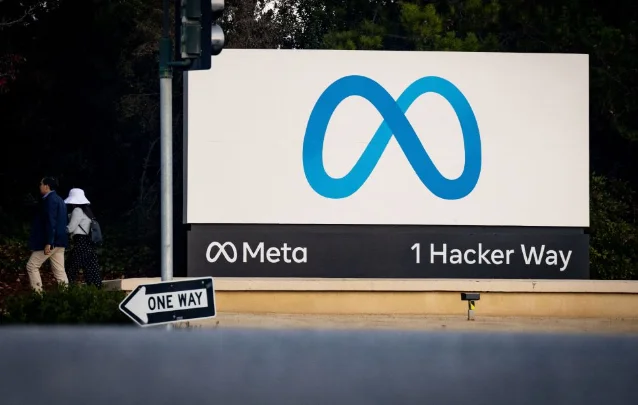
Meta Superintelligence Labs campus sign: Meta's massive AI bet — and the organization that couldn't hold Pang.
Meta's Superintelligence Labs made the biggest single hire in the 2025 transfer window — and lost him in seven months. 2

What GPT United gains

OpenAI does not need introduction. But it does have a specific structural need that Ruoming Pang is built to fill.
Sam Altman's club has spent three years at the top of the AI League table on the back of GPT-4 and then GPT-5's momentum. The challenge now is not building bigger models — it is making models that run efficiently enough, cheaply enough, and reliably enough to power the agentic products the company is betting on for the next phase. That requires exactly the kind of deep systems experience Pang accumulated across two decades: model architecture that optimizes for real-world deployment, not just benchmark scores.
At Apple, Pang architected models for on-device inference with severe memory and power constraints. That problem space — making capable models run inside hard physical limits — is precisely what OpenAI faces as it scales its API and builds toward autonomous agents that run continuously rather than in single-shot conversations.
GPT United now has the engineer who built Apple's on-device intelligence stack sitting inside the lab that most needs to solve the deployment problem. The salary comparison between what Meta paid and what OpenAI likely offered is not public. But Pang's OpenReview profile now lists his current position as engineer at OpenAI — no preamble, no fanfare. He arrived and went to work. 7

The historical parallel: Neymar's $222M PSG move, and the quiet return

Loading chart…
In August 2017, FC Barcelona reluctantly accepted Paris Saint-Germain's activation of the release clause in Neymar's contract: €222 million, world-record fee, the player gone in a single devastating announcement. Neymar spent two years at PSG and then spent two more years trying to leave. The football worked; the environment did not. By 2019, the rumors of a Barcelona return had become a transfer saga that dragged through two windows before collapsing.
The parallel is not exact — Pang's timeline was sharper, his exit cleaner, and his new destination rivals rather than matches his old one. But the underlying dynamic is the same: the best engineers are not commodities that move with the money. They move for the work, the team, and the environment — and the league's most expensive signing discovered in seven months that the organization behind the record fee was not yet the organization the fee implied it would be.
Meta will build that organization. It has the capital, the mandate, and the talent remaining in TBD Lab and FAIR to eventually get there. But for now, the 2025 transfer window's biggest deal produced a seven-month stint and a clean exit to a rival, and Sam Altman got the foundation model architect for presumably less than the price of the Meta signing bonus.
In the AI League, the transfer window never fully closes.
#AILeague

Add more perspectives or context around this Post.

  • Sign in to comment.